The Logophoros Library
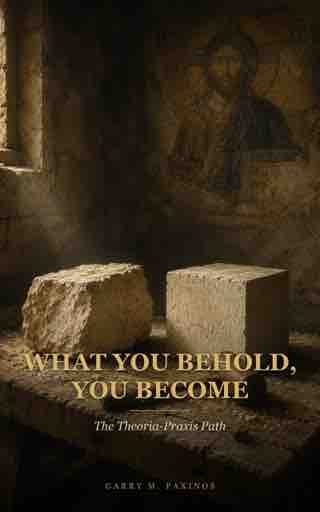
What You Behold, You Become
The Theoria-Praxis Path
If Lost in Translation recovered the words, this book recovers the method. There's an ancient pattern for closing the gap between knowing and becoming. The Greeks called its two movements theoria and praxis. Neither alone suffices. Vision without practice produces spiritual tourists. Practice without vision produces burnout.
Introduction
You've read the books.
Shelves of them, probably. Spiritual classics, theological treatises, wisdom literature from half a dozen traditions. You've underlined passages and copied them out. You know the vocabulary: presence, intention, surrender, formation. You can use it accurately.
And yet.
Something has not moved. The distance between what we know and who we are is exactly where it was. We understand patience and lose our tempers when tired. We could give a clear account of love and still speak sharply to the people who live with us. We have read about peace, prayed for peace, perhaps taught about peace, and we are still awake at three in the morning.
This is not hypocrisy but our ordinary condition, and it is old.
The Greeks named it ἀκρασία (akrasia), literally without power — the state of a man who knows the better course and takes the worse one. Aristotle gave much of a book to it. Paul described it from the inside, and in the present tense: the good that I would I do not: but the evil which I would not, that I do (Romans 7:19). He was an apostle when he wrote it. Modern psychology arrived at the same wall from a different direction and gave it a duller name, the intention–behaviour gap, but it did something the older traditions could not: it measured the thing. Reviewing the meta-analyses in 2002, Paschal Sheeran found that intention accounts for roughly a quarter of the variance in what people actually do. Three quarters of the distance between deciding and doing is unexplained by the deciding. The older Christian writers, working without the statistics, called it the unconverted heart.
The names differ. The experience is identical, and every one of us has it. Knowing does not become being on its own. Information does not produce transformation. Reading about change has never once changed any of us.
I know this pattern from the inside. I have spent decades studying how people are transformed — in Orthodox Christianity, in Freemasonry, in the contemplative traditions of East and West. I can describe the process with some precision. Whether I have actually undergone it is a question I would rather not answer too confidently.
This book comes out of that gap.
A Pattern That Works
There is an old pattern for closing the distance between knowing and becoming. It has been tested for millennia and preserved by traditions that take human formation seriously, which is a smaller set than it sounds. Most institutions that talk about transformation are in fact organised around information. It is almost embarrassingly simple to state and very hard to live, which is why most of us spend our lives circling it while appearing to pursue it.
It has two movements: θεωρία (theoria) and πρᾶξις (praxis).
Theoria is not analysis but vision: contemplation, beholding, reception. It is what happens when we encounter something real and are altered by having seen it. Praxis is action: practice, discipline, the labour of working what we have seen into the fabric of an ordinary week.
Neither alone will do, and each fails in its own characteristic way. Theoria without praxis produces the spiritual tourist, who collects insights like souvenirs and never unpacks them. Praxis without theoria produces the religious mechanic, who performs the motions faultlessly and meets nothing the motions are for. Both are recognisable. Most of us are one or the other by temperament, and we tend to mistake our particular deformity for our particular gift.
The pattern needs both, in rhythm, over years.
None of this is news. Every serious tradition knows it. But knowing about the pattern and working the pattern are two different things, which is precisely the problem the pattern exists to solve. We are caught in a loop: the cure for our condition is itself subject to our condition. We can read about the difference between reading and doing, and file it under things we have read.
The only way out of the loop is to begin.
Where I Am Standing
A word about whose book this is, because it is about to ask you to commit to something, and it would be dishonest to ask that while declining to say what I am committed to.
The pattern is genuinely universal. It appears wherever we are actually transformed — in the monastery and the workshop, the training hall and the practice room, the studio and the sickroom. I will show it to you in those places, because the evidence matters and because a pattern that only worked inside one tradition would be a house rule rather than a truth about persons.
But nobody practises religion in general. There is no generic prayer, offered by a generic person, in a generic tradition. Transformation happens in particular places, with particular disciplines, under particular teachers, and it happens to a man with a name and a history and a specific set of faults. Which is to say it happens to us, or it does not happen. So when this book stops describing the pattern and starts demonstrating it, I will demonstrate it where I actually stand: in Orthodox Christianity, and in the Craft. I know the Church of Greece has spoken against the Craft; this book does not settle that question, and it asks no Orthodox reader to join a Lodge.
If that is your ground too, the specifics will be usable as they are. If it is not, the pattern still holds, and your own tradition will have its equivalents — its sources of vision, its disciplines, its elders, its rooms where formation happens. Find them, and go deep in one place. What I would ask is that you not read this as a menu. The chapters ahead argue at some length against sampling, and it would be strange to make that argument in a book designed to be sampled.
How to Read This
Most books are meant to be consumed. This one is meant to be worked.
Read it slowly — one chapter at a sitting, then stop. What would you lose by going more slowly than you want to? Sit with whatever unsettles you rather than hurrying on to have the unsettlement resolved. The unsettlement is not the obstacle but the work; resolution on the same afternoon is usually just relief.
At the end of each chapter there is a section called The Work. These are not devotional extras for the especially keen. They are the praxis that completes the reading, and, more important than anything else in these instructions, they are cumulative. Each builds on the last. By the final chapters you will not be designing a practice from scratch. You will be looking at the one you have been quietly building since chapter one.
Skip them and you will have read a book about transformation, which is exactly the thing this book exists to warn against.
The book has two movements. The first five chapters are theoria, what to see: the pattern itself, why it comes apart in us, the principle underneath it, where it leads, and what it looks like in the people who arrived. The last two are praxis — what to do, and when to start.
The proportion is deliberate and it is lopsided on purpose. The seeing is mine to offer. The doing is yours, and no amount of my writing can do it for you.
There is a longer book behind this one, From Vision to Reality, which takes each of these territories much further: Revelation read as the most sustained theoria in the Christian canon, the liturgical year as an annual engine of formation, the degrees examined in detail, the obstacles and dark nights that derail practitioners. The appendix says where to find it. This book gives you enough to understand the pattern and begin working it.
Most people never get past understanding.
The Invitation
Here is the uncomfortable part: you can finish this book unchanged.
You can read every chapter, agree with all of it, admire the elegance of the thing, and remain exactly who you were. I cannot make you slow down or attempt the work. You can shelve this with the others, and it will look well there.
Or you can begin. Not when you have finished reading. Not when circumstances improve, because circumstances do not improve. They only change shape. Now, with whatever partial understanding you have at this moment, which is all anyone has ever started with.
Before you turn the page, stop for thirty seconds and ask: What would it mean if this were actually possible? What would I have to give up? What would I have to begin?
Let the questions sit. Then go on.
Be ye transformed by the renewing of your mind.
Romans 12:2
Contents
- — Introduction
- 1 The Pattern Hidden in Plain Sight
- 2 Why Information Doesn’t Transform
- 3 What You Behold, You Become
- 4 The Goal, and the People Who Reached It
- 5 When Vision and Practice Become One
- 6 Where You Are, and What to Do About It
- 7 Begin Now
- — Appendix: Going Deeper
- — Glossary
The rest is coming soon
Seven chapters, from seeing the pattern to beginning the work. Subscribe for chapter previews, word studies, and word when the book is released.
Subscribe on Substack