The Logophoros Library
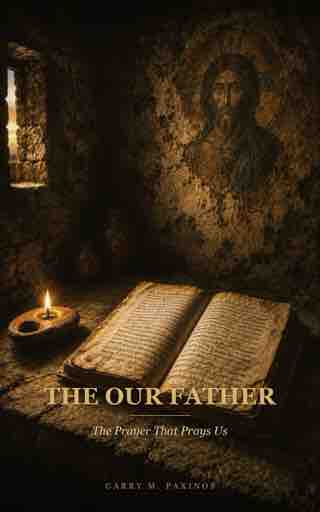
The Our Father
The Prayer That Prays Us
Sixty words you have said your whole life, taken one line at a time — down to the Greek the Fathers actually wrestled with, and back up into the life the prayer is quietly training you to live.
Introduction · An Overview of the Our Father
I have been saying the Lord's Prayer my whole life. Long enough that I can say it without being there for it, the way you can drive home and not remember the drive. The words come out smooth and worn, like stones in a riverbed, and most mornings I am three lines in before I notice I have started.
That smoothness is the problem.
We assume the things we know best are the things we understand best. With the Our Father it is the reverse. The familiarity is a kind of varnish. It lets the words slide past the mind without ever catching. We have said thy kingdom come ten thousand times without once asking what we just asked for, and whether we would recognize it, or want it, if it came.
This book is an attempt to scrape off the varnish. To take the prayer one line at a time, slow it down, get under the English to the Greek the Fathers actually wrestled with, and find out what we have been saying all these years.
I should warn you at the outset: it is stranger than you think.
The Whole Gospel in Sixty Words
The early Church did not treat this prayer as a nice devotional starter. They treated it as the thing itself. Tertullian called it breviarium totius evangelii, the summary of the entire gospel. Whole treatises were written on these few lines: Origen in the East, Cyprian in the West, Cyril of Jerusalem teaching the newly baptized, John Chrysostomos preaching it to a city, Gregory of Nyssa devoting five homilies to it, Maximos the Confessor reading it as a compressed map of the soul's entire journey to God.
Five homilies. On some sixty words. These were not men short of material. They lingered because they had found that the prayer does not end. You go down into a single clause and it opens beneath you.
The Fathers did not read the Our Father as a list of things to ask for. They read it as a shape, an architecture, and the shape is the whole of the spiritual life in miniature. Christ was not only telling us what to pray. He was, in the order of the words, teaching us how to ascend.
The Shape of the Prayer
Here is the whole of it, set out the way the Church prays it:
Our Father, who art in heaven,
hallowed be thy name.
Thy kingdom come.
Thy will be done, on earth as it is in heaven.
Give us this day our daily bread.
And forgive us our debts, as we forgive our debtors.
And lead us not into temptation,
but deliver us from evil.
For thine is the kingdom, and the power, and the glory, forever. Amen.
Look at the prayer as a movement, and a structure appears that you cannot un-see.
It begins in heaven. The first half is not about us at all. Our Father, who art in heaven. Hallowed be thy name. Thy kingdom come. Thy will be done. Father, name, kingdom, will. Four times we lift our eyes off ourselves and onto God. We have asked for nothing but him: his name made holy, his reign arrived, his will accomplished. Before you are allowed to want anything, you are made to look up.
And in Greek those three petitions move in lockstep: ἁγιασθήτω (hagiasthētō), let it be hallowed; ἐλθέτω (elthetō), let it come; γενηθήτω (genēthētō), let it be done. Three commands of the same decisive kind: not three wishes but three imperatives, the same grammatical drumbeat struck three times, as if the one praying were calling a whole new world into being. Which, it turns out, is precisely what we are doing.
Then it descends. Give us this day our daily bread. And forgive us our debts. And lead us not into temptation, but deliver us from evil. Bread, forgiveness, protection. Now we are on the ground, in the body, in the wreckage of ordinary life, asking for the three things a creature actually needs: food for the day, mercy for the past, rescue from what is coming. The prayer that began in the throne room ends in the dirt, which is exactly where we live.
And then, in the form the Church has prayed for nearly two thousand years, it returns to glory. For thine is the kingdom, and the power, and the glory. Up, then down, then up again. Heaven, to earth, to heaven.
It is the same motion as the Incarnation itself: God comes down into our need and lifts it back up into his glory. When you pray the Our Father, you are tracing, with your own mouth, the path that God walked toward you, and the path he means to walk you back along.
θεωρία (theoria) and πρᾶξις (praxis), Spoken Aloud
There is a pattern that runs through all of Eastern Christian thought, and once you have seen it you find it everywhere: theoria and praxis. Vision and practice. Contemplation and action. The conviction, against every instinct of our activist age, that you cannot do what you have not first seen. Vision comes first. Practice flows from it. And in the doing, the vision deepens, and the circle turns again, rung by rung up what St John Climacus called the Ladder of Divine Ascent, as you become what you have beheld.
The Our Father is that pattern set to words.
The first half is theoria: the lifting of the eyes, the vision of the Father, his name, his kingdom, his will. The second half is praxis: the descent into the day's bread, the debts to be forgiven, the temptations to be survived. You are given the vision, and then sent down into the ground where it has to be lived. And the prayer assumes you will come back tomorrow and do it again, a little changed, having become, by a fraction, more like what you have been looking at.
This is why the Fathers could read the same sixty words their whole lives. The prayer is not information you absorb once. It is a discipline that re-forms you each time you submit to it. Evagrios said that if you truly pray, you are a theologian, and if you are a theologian, you will truly pray. The Our Father is where that begins. It is theology you can kneel inside.
We Pray What We Cannot Yet Be
Here is the part I find most difficult, and most hopeful.
Almost nothing in this prayer is true of me yet.
I ask that God's name be hallowed, made holy, but my own life does not yet make it holy. I ask that his kingdom come, while half of me is quietly defending the little kingdom of myself. I ask that his will be done in me as it is done in heaven, knowing my will fights his most days before breakfast. I ask to forgive as I have been forgiven, and I have not, not fully, not the people I find hardest to release.
So am I lying every time I pray it?
No. I am being trained.
This is the secret logic of the whole prayer, and the reason this book exists. We do not pray the Our Father as a report on who we are. We pray it as a description of who we want to be. We pray what we cannot yet see, so that we may become it. The words run ahead of the soul on purpose, the way a parent says a child's name over them before they have grown into it. To pray thy will be done before you mean it with your whole heart is not hypocrisy. It is rehearsal. It is the will being slowly bent, one morning at a time, toward the day it will be true.
The Eastern Church has a word for the goal of all this: θέωσις (theosis). Union with God, not absorption, not the loss of yourself, but the human being so saturated with God that, as the Fathers loved to say, the iron in the fire takes on the properties of the flame while remaining iron. The Our Father is the daily, ordinary, almost invisible practice of theosis. It is how the fire gets into the iron. Sixty words at a time.
Our, Not My
One more thing, before we begin, and it is the first word.
Our. Not my Father. Our.
The prayer opens πάτερ ἡμῶν (Páter hēmōn), Father of us. You cannot pray it alone, even alone. The grammar will not let you.
That is the prayer we are going to walk through, line by line, in the chapters that follow. We will go down into each clause as far as it will take us, into the Greek, into the Fathers, into the strange and bracing readings that the smoothness of the English has hidden from us, and then come back up into the question that finally matters: what would it mean to actually pray this, and be changed by it, tomorrow morning?
We begin where the prayer begins. With the most ordinary, and most outrageous, word a human being can say to God.
Father.
Contents
- — Preface: How to Read This Book
- — Introduction: An Overview of the Our Father
- 1 Our Father Who Art in Heaven Adoption, the audacity of Páter hēmōn, and why you cannot say it alone.
- 2 Hallowed Be Thy Name Making holy what is already holy, and the road to the Jesus Prayer.
- 3 Thy Kingdom Come A reign, not a realm — and the throne you are sitting on.
- 4 Thy Will Be Done, on Earth as It Is in Heaven Gethsemane, synergy, and Maximos on the two wills of Christ.
- 5 Give Us This Day Our Daily Bread Epiousios, the word found nowhere else in Greek, and why the Fathers read it at the altar.
- 6 And Forgive Us Our Debts The one conditional in the prayer, and the terror hidden in the word as.
- 7 And Lead Us Not into Temptation Why God tempts no one, and the difference between a test and a trap.
- 8 But Deliver Us from Evil The enemy named at last, and the hand that reaches into the pit.
- 9 For Thine Is the Kingdom The doxology, and why theology ends, always, in praise.
- — Appendix: The Whole Prayer at a Glance
- — Appendix: The Text Behind This Book
The rest is coming soon
Ten short chapters: an introduction, then one for each line of the prayer. Subscribe for chapter previews, word studies, and word when the book is released.
Subscribe on Substack