The Logophoros Library
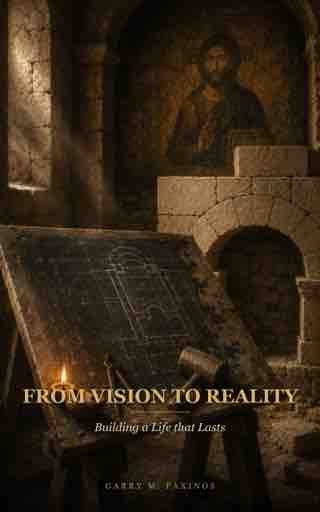
From Vision to Reality
The Theoria-to-Praxis Path
The complete work. Forty chapters tracing the full arc of transformation through integrated contemplation and action. Part systematic theology. Part practical manual. Part invitation to begin.
Preface · Why This Book Now
I am a fraud.
Not in the sense of deliberate deception, but in the older, more terrible sense: the gap between what I profess and what I am. I know things I don't live. I've seen truths I haven't embodied. I've received light I haven't carried into the world's darkness.
If you're honest, you probably are too.
We live in an age of unprecedented access to wisdom. Orthodox Christians have the Church Fathers at their fingertips. Masons can study the philosophical works of centuries in an evening. Spiritual seekers of all kinds can download teachings that would have required years of pilgrimage to encounter in previous eras. We know more than any generation in history.
And yet we're not notably more transformed.
The crisis of our age isn't ignorance. It is not a lack of data, but a failure of integration—the chasm between what we know and who we are, between the vision we've received and the life we actually live. We collect spiritual experiences like tourists collecting photographs, evidence of places we've been but that have left no mark on us. We know the right answers, hold the right beliefs, perform the right rituals. But somehow the knowing doesn't translate into being.
This is my story. Perhaps it's yours too.
The Journey to This Book
I was born into Orthodox Christianity. Both my parents were Greek Orthodox, and I grew up immersed in the rhythms of the Church—the incense, the icons, the liturgical calendar that marked time not by secular holidays but by feasts and fasts. Orthodoxy wasn't something I chose; it was the air I breathed, the world I inhabited before I had words to describe it.
But growing up is complicated, especially in America where religious boundaries are porous and curiosity is encouraged. In my early years, I drifted between traditions. I attended Presbyterian Sunday school for convenience until my home parish, St. Demetrios, established its own program. When my public school burned down, I spent a year in a Lutheran school absorbing a different liturgical vocabulary. By high school, I was immersed in the passionate, non-liturgical faith of Baptist friends while still attending the Greek Orthodox church and its youth activities.
College opened other doors entirely. Studying physics and electrical engineering, I encountered Hinduism, Buddhism, and the Tao—not as conversion attempts but as ways of understanding reality that seemed to resonate with quantum mechanics and systems theory. The Eastern philosophical traditions spoke a language that complemented the equations I was learning. At work, colleagues introduced me to the Western mystery traditions. I read Crowley, Blavatsky, Israel Regardie, and Isha Schwaller de Lubicz voraciously, trying to map the territory of consciousness that science alone seemed unable to fully chart.
For years, I wandered. Not away from Orthodoxy exactly, but around it, investigating what else was out there, testing whether the faith of my childhood could withstand adult scrutiny, whether it was merely ethnic identity or something deeper. I was that common cliché: the cradle Orthodox who knows the rituals but not necessarily their meaning, who has the forms but questions whether there's substance beneath them.
The way back wasn't dramatic. There was no lightning-bolt conversion, no single moment when everything shifted. Instead, it was gradual—a growing recognition that what I'd been seeking elsewhere had been at home all along, but I'd needed the journey to appreciate what I'd inherited. The Buddha's insights on attachment? The Fathers had mapped that territory as "passions" to be purified. The Tao's emphasis on living in harmony with the Way? The Orthodox spoke of synergy with divine energies. Crowley's talk of gnosis and transformation? The patristic tradition called it theosis and had been practicing it for two millennia.
I found my way home. Not back to childhood's unreflective participation, but forward to adult engagement with ancient wisdom. My initial focus was patristic theology—I devoured J.N.D. Kelly's Early Christian Doctrines, traced the development of Christology through the councils, studied the Cappadocian Fathers' Trinitarian theology. I wanted the intellectual framework, the systematic understanding of what the Church taught and why.
But increasingly, I found myself drawn not to theology about the Church but to the theology of the Church—specifically, the theology embedded in the Divine Liturgy itself. Here was the faith not as a premise to be debated, but a country to be entered. The liturgy wasn't just teaching about heaven touching earth; it was heaven touching earth. It wasn't describing the communion of saints; it was that communion made present. Every Sunday, the same movements, the same prayers, the same Eucharist—and yet never merely the same, because repetition revealed depth rather than exhausting it.
The liturgy became my theological home. Not instead of patristic study but as its living context. The Fathers weren't writing systematic theology in the modern sense; they were unpacking what happened in worship, explaining the transformation that occurred when the Church gathered. Their theology was doxological—rooted in and pointing back to the liturgical encounter with the Risen Christ.
And yet, even as I fell in love with the Divine Liturgy, even as I began to grasp its theological sophistication and transformative intent, I struggled with the same gap I'd felt as a teenager: knowing wasn't the same as being. I could explain the liturgy's structure, articulate its theology, trace its historical development. But in my daily life—in my work, my relationships, my responses to stress and disappointment—I remained fundamentally unchanged. The Light I encountered on Sunday seemed unable to survive the sunrise of Monday.
Around the same time, I was deepening my involvement in Freemasonry. My father, grandfather (mother's side), and uncles had all been Masons . I'd been in DeMolay in High School , yet many years passed before I petitioned. I filled out the paperwork and heard nothing—until a decade later, when the Senior Deacon called and asked if I had petitioned years earlier. Seems my petition had been lost behind the Secretary's desk and had just been found after his passing. Timing is everything. The timing was now right for me to join.
As I progressed through Freemasonry, I began to notice something. The Craft's emphasis on ritual, on memorization, on repeated performance of the same ceremonies, on degrees as progressive initiations—all of this had something in common with the liturgical life I was encountering in Orthodoxy. Both traditions insisted that you couldn't just read about it, think about it, discuss it. You had to experience it, repeatedly, until it became part of you.
And yet, even as I noticed the similarity, I struggled with the same disconnect. I could deliver ritual flawlessly. I'd memorized entire degrees. I'd advanced through various appendant bodies, collected the knowledge, received the wisdom. And still, in the quarry of my own character, the rough ashlar remained largely rough.
What was I missing?
The Discovery
The breakthrough came, oddly enough, through my work in artificial intelligence and communications systems. I'd been working on a project that involved training Deep Learning / Large Language Models to detect various persuasion techniques used in modern media (see https://nooz.ai). Through this work I learned how they internalize patterns from vast corpora of text, how understanding emerges not from explicit programming but from exposure to enough examples that the model begins to grasp the underlying structure.
One evening, preparing to deliver ritual in Lodge, I had a sudden recognition: This is what ritual memorization is. Not rote learning of dead words, but internalization of living patterns. The ritual isn't a database of words to be queried; it's a structure to be absorbed until you begin to think through it rather than merely about it.
But even this realization, profound as it felt, left me with the central question: Why did some Brothers seem genuinely transformed by the Craft while others remained unchanged despite decades of participation? Why did some Orthodox Christians radiate a quality of presence—a depth, a peace, a luminosity—while others (myself included) seemed merely religious?
The answer, when it finally came, was both obvious and humbling: The vision had to precede the practice, and the practice had to be sustained until vision and life became one.
I'd been doing it backwards. Or rather, I'd been doing half of it. Sometimes I had vision without practice—sublime moments of encounter that I never allowed to cost me anything. Other times I had practice without vision—going through motions, performing duties, checking boxes, but disconnected from the transformative reality the forms were meant to convey.
What I hadn't grasped was the pattern, the sequence, the patient rhythm of transformation that every authentic spiritual tradition teaches: Receive the vision, struggle to embody it, persist through failure, become what you've beheld.
The Greeks had words for this: θεωρία ("theoria"—contemplation) and πρᾶξις ("praxis"—action). Contemplation and action. Vision and embodiment. Not separate steps, but as movements in a single breath, a rhythm of receiving and responding, beholding and becoming.
And then I saw it everywhere.
In the Book of Revelation, which the Orthodox read as liturgical prophecy—John sees the throne room (theoria) before he endures the tribulation (praxis), and the pattern culminates in the New Jerusalem descending, vision and reality united.
In the Masonic degrees—the candidate receives Light (theoria) and then must work the stone of his character with the tools he's been given (praxis), degree by degree, until he stands in the East having been transformed by what he's beheld.
In the Divine Liturgy—the faithful enter the worship that joins heaven and earth (theoria) and are then dismissed with "Let us depart in peace" (praxis)—sent to live what they've celebrated.
In the Desert Fathers—contemplative prayer (theoria) producing ascetic practice (praxis), which deepens contemplation, which strengthens practice, spiraling upward toward union with God.
The pattern was universal because it reflected something true about how humans are transformed. We don't change primarily through information or willpower. We change through sustained exposure to realities greater than ourselves—through beholding—and then through the long work of allowing what we've beheld to reshape everything else.
Why This Book
This book is my attempt to articulate what I've learned and am still learning about this pattern. It's written from within the Orthodox Christian and Masonic traditions because those are the contexts I know, the waters I swim in. But the pattern itself is universal, and I've tried to show how it appears across multiple domains—in monasteries and martial arts dojos, in artist studios and craftsmen's workshops, in the spiritual life and the ordinary daily grind.
For Orthodox Christians, I hope to show how the ancient pattern of theoria-praxis, which runs through the Fathers and the liturgy, provides a framework for understanding transformation that's both thoroughly traditional and urgently relevant. Not pious ornamentation, but the Church's emphasis on liturgy, sacraments, and contemplative prayer isn't pious ornamentation but the essential structure through which humans encounter God and are changed by what they encounter.
For Masons, I hope to recover the initiatic depth of the Craft by showing how the degrees function as progressive theoria—visions that must be embodied through long practice before their transformative power is released. I want to honor the tradition while also challenging those of us who've collected degrees like merit badges without allowing them to actually change us.
For spiritual seekers of all kinds, I hope to provide a map for the territory you're trying to cross—the gap between aspiration and reality, between who you want to be and who you are. The theoria-to-praxis pattern offers both diagnosis (why you're stuck) and remedy (the path forward).
For skeptics and the curious, I hope to show that what religious and fraternal traditions call "transformation" isn't magical thinking or wishful self-deception, but a process that has coherence, structure, and reproducible results. The pattern works because it aligns with how humans actually change, how attention shapes desire, how sustained exposure to beauty, truth, and goodness gradually makes us beautiful, truthful, and good.
What This Book Is Not
This is not a comprehensive treatment of Orthodox theology, Masonic philosophy, or spiritual formation. Each chapter could be expanded into its own book, and I'm keenly aware of how much I'm leaving out.
This is not a scholarly monograph. While I engage with sources and try to be accurate, my goal is understanding and application, not academic exhaustiveness. Specialists in patristics, liturgiology, or Masonic history will undoubtedly find places where I've simplified or where deeper nuance could be added. I accept that limitation for the sake of accessibility.
This is not a recipe book. Transformation is a mystery, not a mechanism. The pattern I'm describing is real, but it's not mechanical. Two people can follow the same practices and experience different results, because we're dealing with persons (human and Divine) not with machines. What I offer is a framework, a map—but you have to walk the territory yourself.
This is not the definitive word on theoria and praxis. The Orthodox Church has two millennia of reflection on these concepts. Masonry has centuries of philosophical development. I'm standing on the shoulders of giants, trying to see a bit further by virtue of their height. My contribution, if it is one, is in the synthesis—seeing how this ancient pattern illuminates everything from ritual memorization to machine learning, from the Book of Revelation to the Entered Apprentice degree.
How to Read This Book
You can read this straight through, and I've structured it to build progressively from foundations through applications to integration.
But you can also enter through whatever door is most relevant to you:
- If you're drawn to Scripture, start with Part II on Revelation
- If you're Orthodox or liturgically oriented, begin with Part III on the Divine Liturgy
- If you're a Mason, dive into Part IV on the degrees
- If you want practical application first, skip to Part V on universal patterns
- If you're struggling with obstacles, go directly to Part VI
The pattern appears at every level, so wherever you enter, you'll encounter the whole. Like a hologram, each part contains the image of the complete thing.
I've included practical exercises in Appendix B because I believe understanding without application is just more theoria without praxis—the very problem we're trying to solve. I encourage you to try them. This isn't a book to agree with but a book to practice.
A Personal Word
I'm still learning this. The gap between what I've seen and who I am remains vast, though perhaps slightly less vast than it was. I still fail daily to embody what I know. I still get frustrated with the slowness of transformation, still want the shortcut that doesn't exist.
But I've learned to trust the pattern. When I receive vision—in liturgy, in prayer, in the contemplation of sacred texts and symbols—and then struggle, however imperfectly, to live accordingly, something slowly changes. The rough ashlar gets a bit smoother. The nous gets a bit clearer. The distance between Sunday and Monday shrinks slightly.
It's not dramatic. Rarely is there a moment when everything shifts. More often it's invisible, incremental, so gradual that I only notice in retrospect that I'm not quite the same person I was five years ago, that struggles that once dominated me have loosened their grip, that virtues I once had to consciously choose are becoming more natural.
This is the promise: not instant transformation but real transformation. Not dramatic conversion but steady conversion, ongoing turning, perpetual returning to the vision and working out its implications.
"Behold, I am making all things new," says the One on the throne in Revelation. Not "I will make" in the distant future, but "I am making"—present progressive. A work underway. And the way He makes us new is through the pattern: we behold Him, we struggle to embody what we've seen, we persist through failure, and we slowly, mysteriously, become what we've gazed upon.
The Invitation
If you're reading this, you probably feel the disconnect too. Between belief and practice. Between Sunday and Monday. Between the Mason you pledged to become and the man you see in the mirror. Between the Christian you profess to be and the person your family lives with. Between your best moments of insight and your ordinary hours.
The gap is not a failure. It is the human condition. What varies is whether we're working with it intentionally, patiently following the pattern that leads from vision through practice to integration, or whether we're stuck—either spinning in contemplation that never costs us anything, or grinding through practice disconnected from any sustaining vision.
This book is an invitation to work the pattern. To find or return to sources of authentic theoria. To be seized by a vision that's bigger than you, truer than you, more beautiful than you. To carry that vision into the daily struggle with patience and without self-condemnation. To persist when the vision fades and practice feels empty. To trust that what we behold we slowly become, that God is making all things—including us—new.
The journey is long. The transformation is slow. The work is hard.
But it's the only work worth doing.
And you don't walk alone. The Church, the Lodge, the communion of saints, the Brothers who've gone before—all of these are contexts and communities that carry the pattern, hold the vision, and support the practice. You're joining a stream that's been flowing for millennia, a tradition that's been tested across cultures and centuries and found to work.
So let's begin. Or rather, let's continue. Because wherever you are in your journey, you're already in the pattern. The question is whether you'll work with it intentionally or stumble through it unconsciously.
I choose the former. I hope you'll join me.
Come and see.
Then go and live.
Until the gap is closed.
Garry
Feast of the Transfiguration, 2026
Contents
- — Preface: Why This Book Now
- Part I: Foundations - The Grammar of Transformation
- 1 The Ancient Pattern
- 2 The Crisis of Modern Spirituality
- 3 What You Behold, You Become
- Part II: The Blueprint - Revelation as the Master Pattern
- 4 Reading Revelation with New Eyes
- 5 First Movement: The Vision Received
- 6 Second Movement: The Struggle to Embody
- 7 Third Movement: The Call to Overcome
- 8 Fourth Movement: Vision Becomes Reality
- Part III: The Pattern in Christian Worship - The Divine Liturgy as Theoria-Generator
- 9 Liturgy as Encounter, Not Performance
- 10 The Liturgical Structure: Theoria Unfolding
- 11 The Liturgical Year: Cyclical Deepening
- Part IV: The Pattern in Masonic Ritual - From Darkness to Light to Labor
- 12 The Initiatic Structure
- 13 The Entered Apprentice: Theoria of the Moral Foundation
- 14 The Fellow Craft: Theoria of the Intellectual Life
- 15 The Master Mason: Theoria of Death and Resurrection
- 16 The Royal Arch: Recovery of the Lost
- 17 The Scottish Rite: Theoria Expanded
- 18 The York Rite: Chivalric Christianity
- 19 Ritual Memorization as Embodied Pattern Learning
- 20 The Lodge as Sacred Container
- Part V: Universal Applications - The Pattern Everywhere
- 21 The Monastery - The Pattern in Monastic Life
- 22 The Artist's Studio - Creative Theoria-Praxis
- 23 The Warrior's Training - Martial Theoria-Praxis
- 24 The Craftsman's Workshop - Making as Transformation
- 25 The Scholar's Library - Intellectual Theoria-Praxis
- 26 Daily Life - The Pattern in Ordinary Experience
- Part VI: Obstacles and Solutions - When the Pattern Breaks
- 27 The Seven Deadly Disconnections
- 28 Spiritual Bypassing
- 29 Mere Activism
- 30 The Dark Night
- 31 Spiritual Pride
- 32 Failure and Return
- Part VII: Advanced Integration - When Theoria and Praxis Merge
- 33 The Long Loneliness
- 34 Theosis: The Goal of Orthodox Transformation
- 35 Saints As Living Proof - Embodied Theoria
- 36 When Action Becomes Contemplation
- 37 The Community Dimension - We're Not Alone
- Part VIII: The Call Forward
- 38 Assessing Where You Are - Taking Stock
- 39 Designing Your Theoria-Praxis Life - Practical Steps
- 40 The Invitation - Begin Now
- — Epilogue: Vision Becomes Reality
The rest is coming soon
Forty chapters, from the ancient pattern to the call forward. Subscribe for chapter previews, word studies, and word when the book is released.
Subscribe on Substack